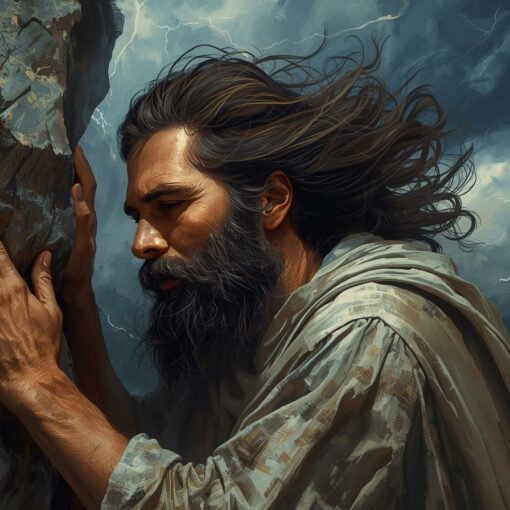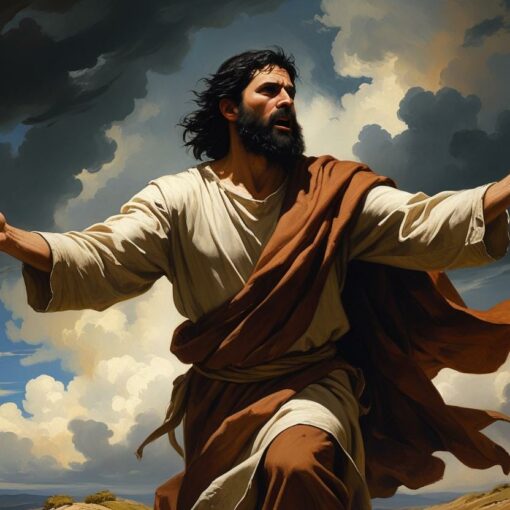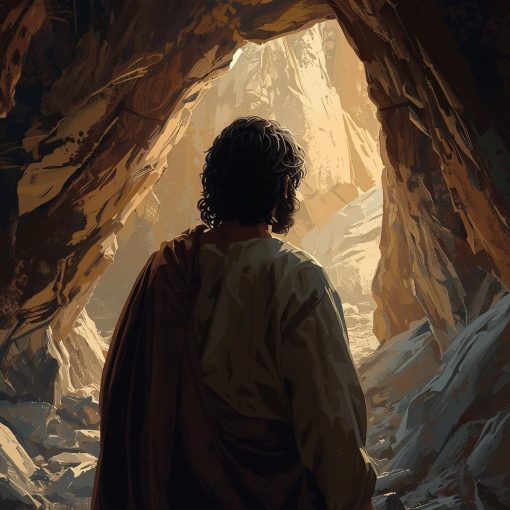

The prophet Elijah teaches us that recognizing and depending on God’s faithfulness replenishes, renews, and restores weary souls. To overcome depletion and burnout, it is essential to seek renewal beyond self-effort. In and of myself, I am incapable of recovering from burnout. My self-effort only leads to a temporary reprieve.
When did Elijah actually get it?
There is a mystery woven into the narrative of 1 Kings 19—a mystery not of failure, but of faithfulness. Elijah, though depleted and disoriented, was never beyond the sovereign gaze of God. He was never unseen. Never forgotten. Never abandoned. Though Elijah removed himself from ministry duty and withdrew into isolation, distancing himself from the calling God had placed upon him, Scripture shows that God remained fixed upon him with unwavering faithfulness.
This is our anchor: God’s sovereign gaze never turns away.
Even during this season of separation and internal collapse, God stayed with Elijah, walking with him, holding fast to him—not because Elijah was strong, but because God could not deny His own faithfulness. This story can teach us all how to overcome depletion and burnout through faith.
If we are faithless, He remains faithful, for He cannot deny Himself.
2 Timothy 2:13 NASB
Jesus affirms this security:
“All that the Father gives Me will come to Me, and I will not lose any.”
John 6:37 NASB
No matter how alone or estranged we may feel, God is with us.
This truth is evident throughout Scripture, but it is profoundly illustrated in Elijah’s time of depletion, showing how essential it is to overcome depletion and burnout through divine support.
God’s Principle in Elijah’s Journey
God has set His sight upon His people in order to redeem, sanctify, and help. Yet this redemption and sanctification seldom unfold as we expect or prefer. Our impulse is to imagine God’s deliverance as something that strengthens us unto self-sufficiency. But God’s work always moves us away from autonomy and toward dependence.
All of grace aims toward forming Christ within us—so that our confidence becomes rooted in God’s strength rather than our own. God works within the economy of faith, and in that realm alone can we actually learn dependence, a necessary step to overcome depletion and burnout.
Precepts and Promises for the Depleted Soul
God is our refuge and strength, a very present help in trouble.
Psalm 46:1 ESV
Behold, God is my helper; the Lord is the sustainer of my soul.
Psalm 54:4 NASB
The Lord is my strength and song, and He has become my salvation.
Psalm 118:14 NASB
‘Do not fear, for I am with you; Do not be afraid, for I am your God. I will strengthen you, I will also help you, I will also uphold you with My righteous right hand.’
Isaiah 41:10 NASB
The Lord is my shepherd; I have what I need.
Psalm 23:1 CSB
Elijah was God’s man, God’s servant, God’s emissary—yet also God’s ward, in need of convalescent care.
So are we.
Being God’s ward does not simply expose Elijah’s weakness but heightens God’s faithfulness. Dependence on our faithful God is the only way to truly overcome depletion and burnout.
Jesus—Our Example of Divine Care Received
The supreme example of holy convalescent care is Jesus Himself.
He was without sin, perfectly aligned with His Father’s will—yet He too required ministering. Twice in the Gospels, angels were sent to attend Him: after His 40 days of spiritual battle, and again in Gethsemane. Psalm 91 foretold such ministry, a promise applied not only to the Messiah but to all who walk in the ways of the Lord.
Jesus, though perfect, was fully human—and therefore lived in ongoing dependence on His Father. Hebrews reminds us that He was tempted in all respects as we are, yet without sin (Hebrews 4:15).
Therefore, His dependence legitimizes ours. To follow His example is to learn how to overcome depletion and burnout.
If Jesus needed the Father’s sustaining care, how much more do we?
The Desert of Self-Sufficiency
Despite knowing God, we are drawn toward self-reliance. We sometimes live as functional atheists—acknowledging God by belief but denying God in practice through self-dependence.
Elijah teaches us that self-sufficiency depletes, while dependence replenishes.
Solomon clarifies this: trusting the Lord renews mind, body, and soul (Proverbs 3:5–8).
The Moment of Transformation
It was not at Carmel.
Not at victory.
Not in the fire.
But at the whisper.
In the presence of God, Elijah became aware of himself again. He understood how self-absorption had stealthily displaced surrender. His mantle covered his face in humility. He saw how self-preservation had warped his orientation to God, reshaped his thinking, and redirected his course.
Elijah confessed.
He heard.
He understood.
Then Elijah returned.
Through divine grace,
faith was restored,
perspective was healed,
and intimacy renewed.
Elijah got it when God became his vision again.
Elijah’s Story Demonstrates God’s Faithfulness
Elijah’s path—from calling, to confrontation, to depletion, to replenishment, to renewal—reveals the heart of divine faithfulness. This series has shown that the center of the narrative is not Elijah’s resilience, but God’s faithfulness.
We are God’s emissaries.
We are God’s warriors.
But we are also God’s wards.
Resilience is not the fruit of personal strength—but the outcome of dependence.
And the sustaining power of that dependence is found beneath the gentle whisper that restores the soul.
The final word in Elijah’s journey is this:
When our strength fails, God holds us.
When our perspective collapses, God restores us.
And when the fire fades, His whisper remains.
Explore more posts from our resilience series, Elijah: Fire, Fear, and Faithfulness—Finding Christ Relevant to the Fragile Moments of Life.
- Resilience Is the Christ-given Capacity to Live Abundantly
- Walking by Faith: Elijah Teaches Resilience Comes from Trust
- Courage and Resilience in the Face of Opposition
- Resilience God’s Way: Not Effort but Anointing
- How to Live a Life of Righteous Acts
- Finding Strength in the Midst of Spiritual Warfare
- Learn Why Faithfulness Is the True Measure of Strength
- Where Is Your Focus? On Faith or Fear?
- Resilience Found in Dependence: Elijah’s Faith and Frailty
- When the Fire Fades Resilience Is Found in Surrender
- Strength for the Weary: Grace in the Midst of Crisis